
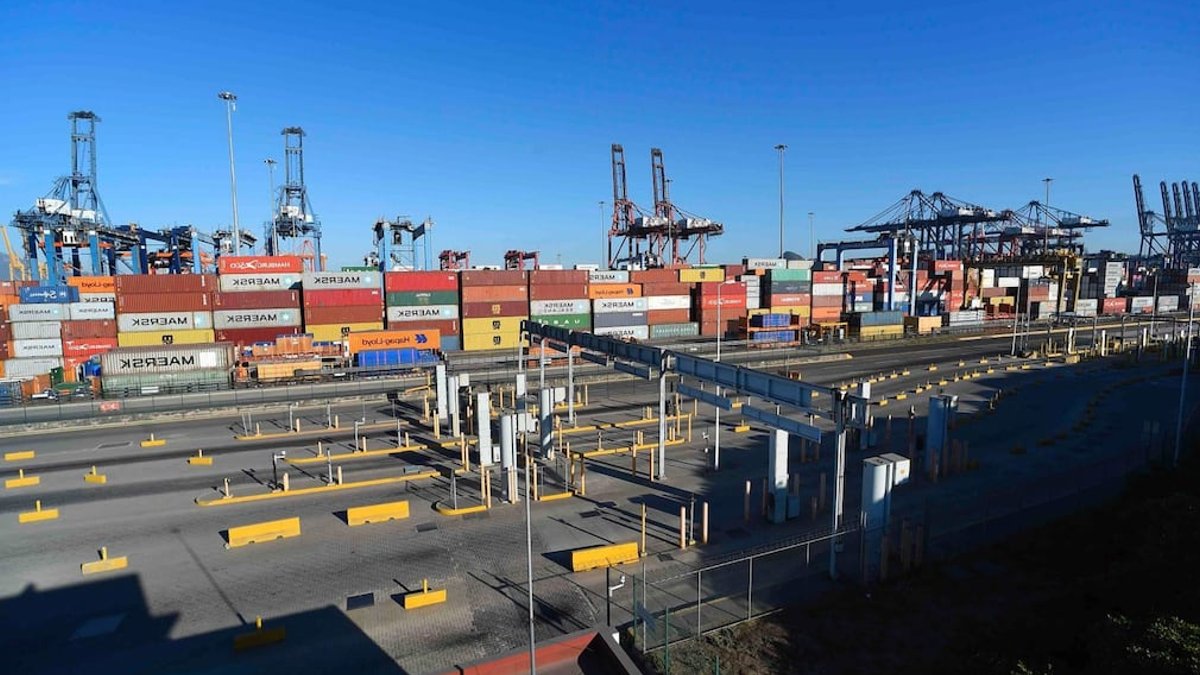
Mexico’s exports to the US reached a record high during the first half of the year, totaling $298.2 billion, a 13% annual increase that solidified the country’s position as the primary supplier of goods to the US market. According to the US Census Bureau, Mexican shipments accounted for 17.1% of all US imports between January and June, allowing Mexico to expand its lead over its main commercial competitors.
Trade Relationship
Canada ranked second with an 11.5% share, followed by Taiwan with 7.8%, while China dropped to fourth place with 7.4%. The strength of the trade relationship between Mexico and the US was also reflected in the total exchange between the two countries. The Undersecretary of Foreign Trade, Luis Rosendo Gutiérrez, highlighted that between January and June, Mexico remained the US’s primary commercial partner, with bilateral trade totaling $493.7 billion, surpassing Canada’s $376 billion and China’s $184.8 billion.
Gutiérrez noted that Mexico continues to grow its exports, with the good news being that it is no longer the second-largest bilateral trade deficit in goods for the US, but rather the third, with Vietnam at $114 billion, Taiwan at $107.2 billion, and Mexico at $102.6 billion.
Related: Probiotic foods boost digestion, study shows
Resilience of Regional Integration
Janneth Quiroz, chief economist at Monex, stated that the performance of exports confirms that the productive integration of North America has withstood the uncertain environment generated by the revision of the US-Mexico-Canada Agreement (USMCA) better than expected. The figures show that, so far, trade between Mexico and the US has been much more resilient than many anticipated, she said.
Quiroz explained that the supply chains built over more than three decades and the high interdependence in industries such as automotive, electronics, machinery, medical equipment, and computers have prevented a disruption in regional trade. However, Gabriela Siller, chief economist at Banco Base, warned that the strong export growth is mainly concentrated in the computer equipment sector, which has a lower economic impact than the automotive industry.
Siller noted that although computer equipment has become the primary product purchased by the US from Mexico, employment and investment in this sector have not grown at the same rate as exports, due to its lower national content. This leads to the understanding that computer equipment has a lower added value and a lower economic impact in Mexico, she said.
Related: Pensions market reaches 1.2 trillion pounds
Commercial Dynamism
The commercial dynamism was also reflected in the flow of goods in the opposite direction. During the first half of the year, US exports to Mexico totaled $195.6 billion, maintaining Mexico as the primary destination for US external sales, ahead of Canada and the United Kingdom. In June alone, Mexican exports to the US reached $55.3 billion, a historic high for that month, representing a 23% annual increase and marking the fourth consecutive month that exports exceeded $50 billion.
With this result, Mexico concentrated 17.4% of US imports in June. According to Quiroz, although negotiations for the USMCA may register episodes of higher volatility, the economic incentives to preserve regional integration remain high. Political uncertainty can generate episodes of volatility, but it is unlikely to modify a productive integration that has been built over more than three decades, she concluded.


Leave a Reply