
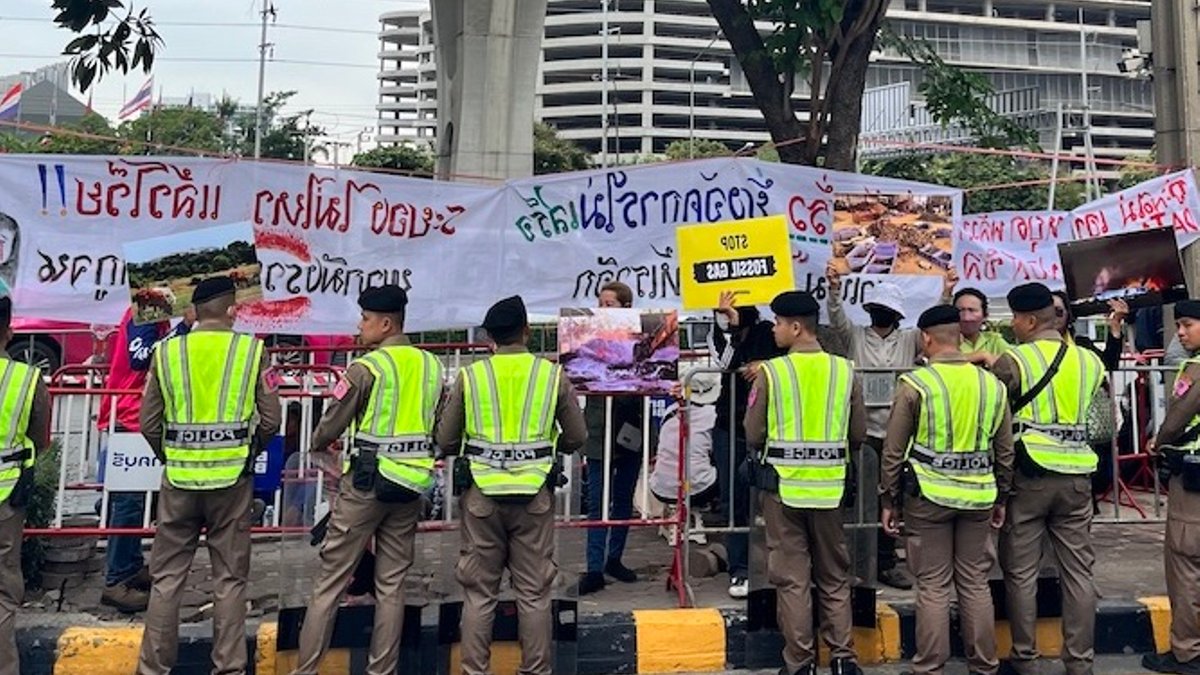
Climate activists in Bangkok are calling for an end to gas expansion in Asia, as the world’s largest exhibition for natural gas, LNG, and other energy sector issues, Gastech 2026, takes place in the city.
The event has reportedly generated an estimated $40 billion in energy agreements and investment plans, according to The Nation, although Greenpeace puts the figure at more than $17 billion.
Protests and opposition
Thousands attended the four-day event, but it faced significant controversy. A large group of protesters gathered outside the Bitec exhibition center, where global gas and energy executives had convened.
Meanwhile, climate activists from East and Southeast Asia held a public forum in another part of Bangkok to discuss strategies against new gas production facilities.
While often promoted as a “transition fuel” to replace coal and combat global warming, climate activists argue it’s a “fossil fuel illusion”.
Read Also: Asian Markets Rally as Fed, Trump Ease Tensions
Targeting public financing
Dawon Hwang from Solutions For Our Climate (SFOC) said her group focuses on stopping Korean public money from funding fossil fuel expansion.
According to Oil Change International, South Korea’s public financial institutions provided an average of $5.7 billion annually from 2017-2024 for international gas infrastructure, making it the second-largest provider of fossil fuel financing among G20 countries after its carbon neutrality pledge.
South Korean industry is actively expanding its oil and gas footprint in Southeast Asia. SFOC estimates South Korean companies lead nine projects in Vietnam, three in Indonesia, and one in Thailand.
These projects are expected to seek backing from South Korea’s public financial institutions, such as Eximbank, reportedly linked to four gas projects in Vietnam and five petrochemical projects in Indonesia.
Dawon Hwang emphasized that “public finance is the hinge” for these projects, stating, “Without it, many of these projects do not stand on their own”.
She warned that many Gastech projects “could lock in gas for decades”, with countries facing volatile prices and permanent commitments.
Read Also: Anthropic to Lease Australia’s Largest Data Center in Queensland
Yujung Shin, from SFOC’s legal team, highlighted the success of an injunction against a $660 million investment in Australia’s Barossa gas project. This led a local court to void the drilling permit, causing Korean financing to lapse in 2024.
She also mentioned opposition to a $562 million Korean public funding plan for Mozambique’s Coral North FLNG project. This resulted in two financiers withdrawing $2.2 billion of planned investment after human rights reviews.
International law may be converging on this issue.
Sutharee Wannasiri from Accountability Counsel emphasized the role of institutional investors in shaping corporate behavior through financial exclusion lists.
As of 2024, approximately 2,900 companies have been excluded in the climate category worldwide, including 260 in ASEAN nations.
In Thailand, 53 companies were excluded from portfolios by 59 investors from 14 countries, primarily in the energy sector.
Read Also: US Confirms Space Weapons, China, Russia Warn Against Militarization
Financial institutions under scrutiny
G20 governments and multilateral development banks are still putting tens of billions of dollars into fossil fuels, allegedly several times what they invest in clean energy.
Eximbank is reportedly linked to four gas projects in Vietnam, plus five petrochemical projects in Indonesia and a gas cogeneration facility in Indonesia.
Accountability Mechanisms and Community Action
A US-based group, Accountability Counsel (AC), defends the human rights and environment of marginalized communities harmed by internationally financed projects. They employ people-led strategies to counter harmful gas and energy initiatives. AC notes that, based on Banking on Climate Chaos, the world’s 65 largest commercial banks committed $906 billion to fossil companies in 2025 – a $108 billion increase from 2024. Since the Paris Agreement, these banks have channeled $8.7 trillion into oil, gas, and coal operations.
Multilateral development banks (MDBs), such as the World Bank Group, Islamic Development Bank, European Investment Bank and the Asian Development Bank, among others, were also providing at least $19 billion a year in oil, gas, and coal projects, However, many MDBs have Independent Accountability Mechanisms to handle complaints from affected communities. These mechanisms have successfully paused or delayed project funding in some cases. AC emphasizes that institutional investors can influence corporate behavior through financial exclusion lists, categorizing companies based on climate change, human rights, and environmental impact.
Legal and financial countermeasures
Yujung Shin discussed the Barossa gas project injunction, which voided the drilling permit and ended Korean financing in 2024.


Leave a Reply