
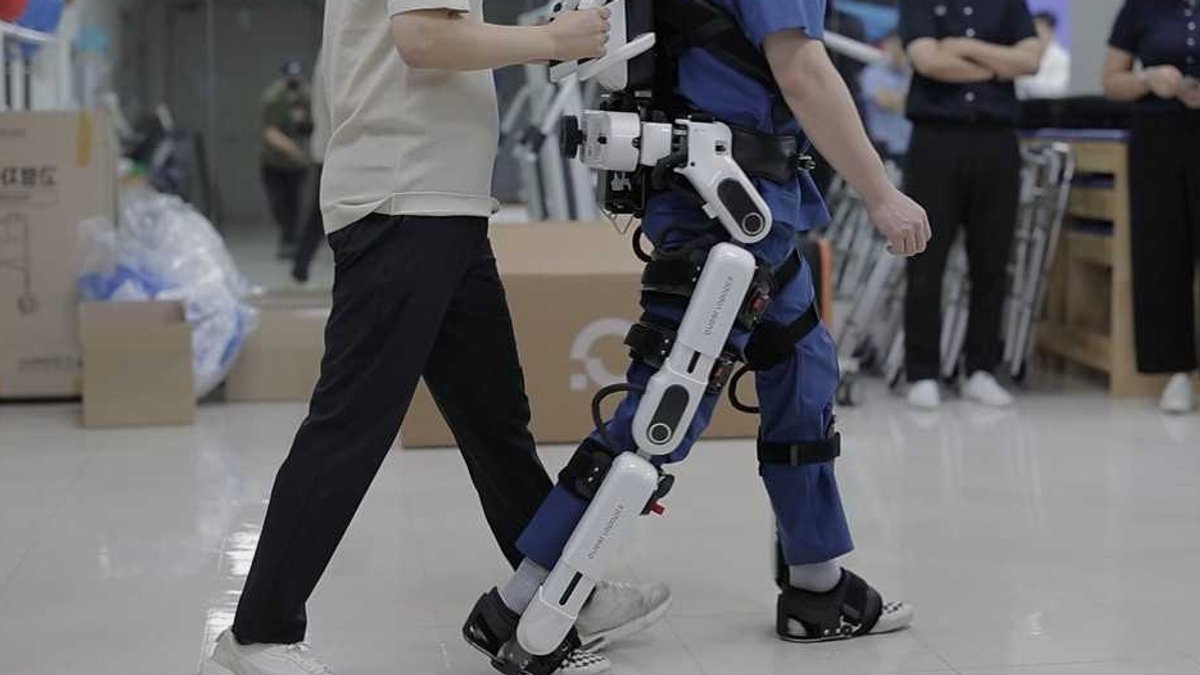
Posco Group is broadening its employee-funded social responsibility efforts, supplying cutting-edge prosthetic limbs to injured veterans and engaging students in practical science learning as a way to bolster local communities and future talent.
Assisting Injured Veterans
Launched in 2013, the Posco 1% Sharing Foundation relies on donations from company staff. Its primary goals include restoring independence for injured service members, improving access to science education, and promoting staff involvement in civic activities.
A key project offers custom-made robotic limbs and mobility aids to veterans, armed forces personnel, and firefighters who were wounded while on duty. Since the project began in 2020, the organization has assisted 219 individuals with a total of 6 billion won distributed over six years, spending around 1 billion won each year.
Standard prosthetics cannot match the adaptability of these high-tech robotic limbs, which can adapt to various walking surfaces, allowing users to handle stairs, hills, and rough ground. The foundation collaborates with the Ministry of Patriots and Veterans Affairs to screen candidates, reviewing their medical history, jobs, and daily living requirements to ensure the right equipment is chosen.
Read Also: Bank of Korea holds rates but hints at future hikes
Services extend beyond the devices themselves, covering professional fitting, user instruction, and ongoing repairs. Beneficiary Choo Yeon-hee experienced lower-body paralysis due to a military accident; after obtaining an advanced walking aid in 2024, she regained the ability to walk with her daughter and perform daily tasks that had been impossible before.
Kim Geun-hyo, who lost his right arm during a coastal defense mission, received a robotic arm in 2023 and now teaches at an elementary school. Beyond individual support, the foundation supplies wearable rehab robots to veteran hospitals across Seoul, Busan, Daegu, Daejeon, and Incheon.
The assistance has also aided recipients in securing jobs and taking part in sports. One recipient secured employment with Posco Humans, the group’s subsidiary for people with disabilities, while another won a cycling gold medal at the 2022 Invictus Games after receiving prosthetic arms.
Science Education in the Classroom
In addition to its veteran work, the foundation operates SangSang Science, a practical science program that started in 2019. This curriculum exposes middle schoolers to technologies relevant to Posco Group’s operations, such as hydrogen steel production, robotics, batteries, and recycling.
Read Also: South Korea emerges as top hub for German firms
Targeted at eighth-grade students in Pohang and Gwangyang—locations of major Posco steel mills—the four-day event utilizes experiments, simulations, and group projects instead of standard lectures.
Participants construct models, manipulate hydraulic robotic arms, and play educational board games to understand low-carbon steel plant operations. The teaching method uses project-based learning, prompting students to diagnose issues, devise solutions, and present their conclusions.
For instance, students examine how substituting fossil fuels with hydrogen in steelmaking reduces emissions, then collaborate to propose eco-friendly production strategies. Since its inception, the program has impacted 26,301 students across 201 schools.
Hiring local university graduates and career changers as instructors helps create jobs in the region while reducing educational gaps. In 2023, a deal with the Education Ministry was signed to extend science lessons to 9,240 students at 90 middle schools nationwide.


Leave a Reply