
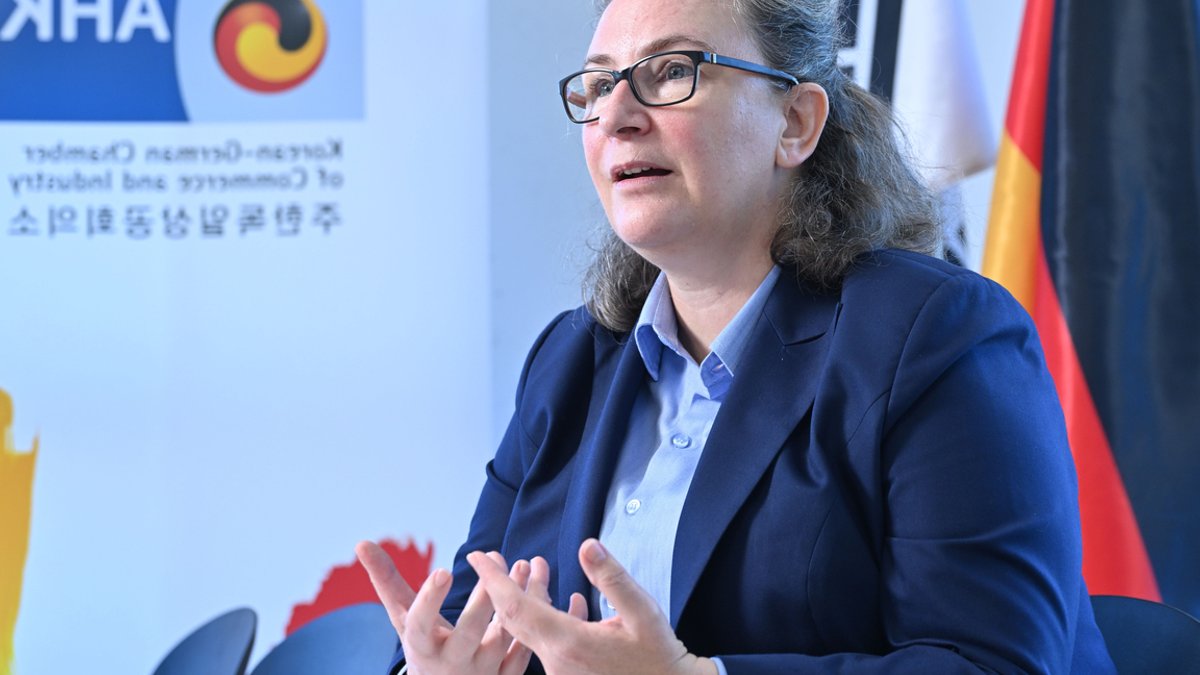
According to the leader of the Korea-German Chamber of Commerce and Industry, South Korea is becoming a key location for German firms that aim to broaden their activities as geopolitical risks increase.
Expanding presence in Seoul
Marie Antonia von Schonburg, who serves as president and chief executive of the chamber, explained that German enterprises are turning to South Korea not only to sell goods but also to establish manufacturing sites, develop technologies and build supply networks that cater to Asian customers.
She made these statements in a Wednesday interview held at the chamber’s headquarters in downtown Seoul. The comments were given ahead of the 19th Asia-Pacific Conference of German Businesses (APK), which will take place in Seoul from October 29 to 31.
Roughly 800 executives and government officials from Germany and the broader Asia-Pacific area are expected to attend. Chancellor Friedrich Merz of Germany will open the forum with a keynote address, and top managers from firms such as Siemens, BASF, DHL, Infineon, Boehringer Ingelheim and Deutsche Bank will also present.
This marks the third occasion Seoul has hosted the biennial gathering, after the 1992 and 2007 meetings, showing the strengthening commercial relationship between the two countries.
Industrial strengths align
Von Schonburg observed that South Korea’s industrial advantages match well with German expertise. She characterized the partnership as a “great fit” that enables both sides to leverage cutting-edge production, a highly qualified workforce and robust infrastructure.
Germany’s know-how in precision engineering, industrial software and automation pairs with South Korea’s capabilities in high-tech manufacturing, semiconductors, batteries and life-science sectors. Such a cooperation is increasingly vital as firms evaluate their Asian footprints against the backdrop of trade frictions between China and the United States.
Von Schonburg emphasized that broadening supply bases does not equate to pulling out of China. Referring to a May 2026 poll of German firms operating in China conducted by the German Chamber of Commerce in China, she indicated that only 11% of participants considered leaving, whereas more than 60% intended to raise their investment levels.
Investment flows into high-tech sectors
The partnership is resulting in concrete capital flows. Approximately 540 German firms are active in South Korea, providing jobs for about 100,000 workers.
Latest capital commitments show attention to life-science and high-technology fields. The German science-tech conglomerate Merck is putting roughly €300 million into a bioprocessing campus in Daejeon, while Sartorius, a supplier of biopharmaceutical equipment, is allocating about €500 million to a plant in Songdo slated to begin operations early next year.


Leave a Reply