
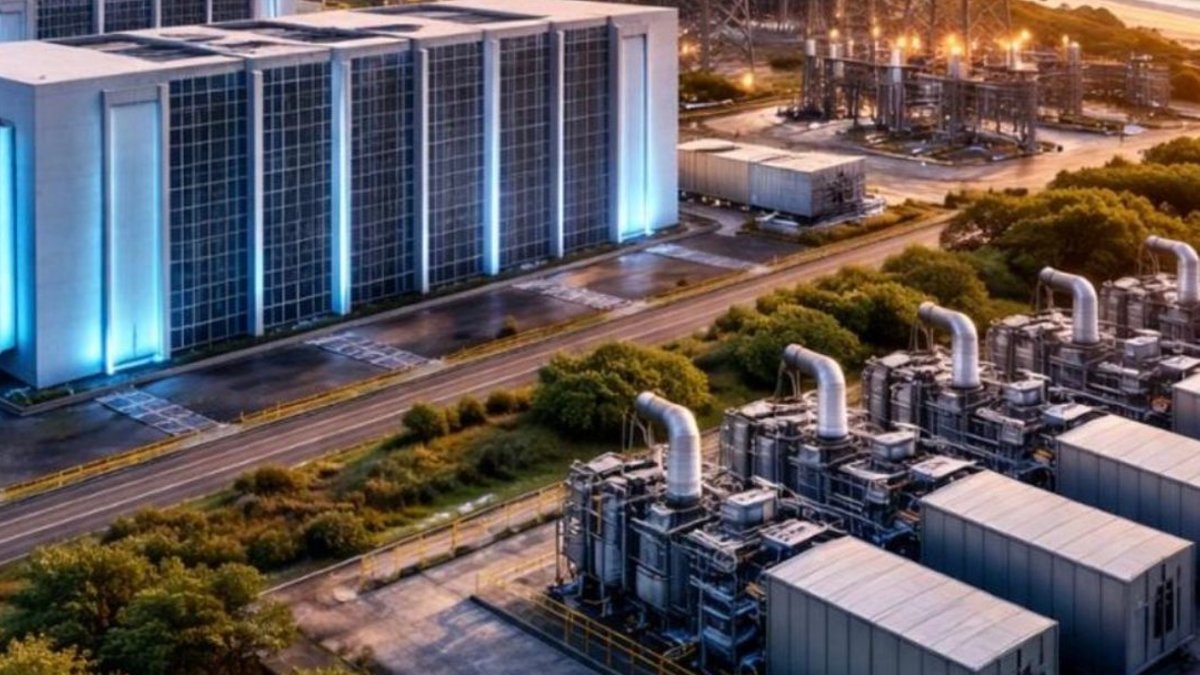
Greek multinational Amaco Energy Group has proposed building one of the world’s largest AI data centres on the coast at Mombasa, Kenya, at a cost of roughly Ksh194 billion, or $1.5 billion. The company’s chief executive, Dr Theodore Theodoropoulos, met with government officials in Nairobi to seek approval for the project, which would be among the largest single foreign direct investments in East Africa’s technology sector.
The proposal stands out due to its power model, which involves generating electricity offshore using a system called Hercules – a liquefied natural gas-powered platform that combines gas-to-power generation, AI-driven load optimisation, and heat and cold recovery. This approach would allow the data centre to operate independently of the national grid.
Addressing Kenya’s Grid Constraint
The Amaco proposal comes as a response to the stalled Microsoft-G42 data-centre project in Olkaria, Nakuru County, which was announced in May 2024. The project’s power requirement was revised upward from 60 megawatts to 1,000 megawatts, but Kenya’s entire installed generation capacity is roughly 3,000 megawatts, making it difficult to absorb the load without disrupting supply to households and industry.
President William Ruto acknowledged in May 2026 that the country’s electricity system could not support a load of that scale. Amaco’s proposal, by generating power offshore, aims to bypass this grid constraint and provide a reliable source of electricity for the data centre.
The company’s Hercules system could also produce surplus power that might be added to Kenya‘s wider electricity supply. However, several material details, including the exact site, financing structure, and construction timeline, remain undisclosed.
Broader Implications for Kenya’s Data-Centre Sector
Kenya is attracting growing attention from multinationals building cloud, AI, and digital-finance infrastructure, driven by rising regional demand for computing capacity. The country’s established technology sector, strong international connectivity, and substantial renewable-energy resources give it a competitive edge.
However, the stall at Olkaria highlights the constraint that increasingly matters most: electricity availability and reliability. As AI computing scales, this constraint may decide which African markets attract the next wave of hyperscale investment. Amaco’s offshore, self-generating model is one answer to this constraint, but its workability at this scale and under Kenyan regulatory and environmental review remains to be tested.
For now, attention turns to whether Amaco will disclose its site selection, IT load, and financing structure, and how the Kenyan government will respond formally to the proposal. The project’s environmental and marine-works approvals, as well as its emissions profile, will also be closely watched. The claimed surplus-electricity contribution to the grid and its commercial terms are additional factors that require clarification.
Amaco’s proposal is part of a larger contest playing out across the continent over the physical foundations of the AI economy. African markets are competing for cloud companies, AI developers, and the necessary infrastructure, including electricity, fibre, land, and water. The outcome of Amaco’s proposal will be closely watched as a potential template for addressing the power challenges facing data-centre development in the region, with the company citing a target of four gigawatts of aggregate net capacity by 2030.
Technical and Financial Questions
Industry analysts have noted that several technical and financial questions remain unanswered, including the distinction between nameplate and firm capacity. The company has not disclosed the intended IT load, the facility’s power-usage effectiveness ratio, or its redundancy class, making it difficult to assess the project’s viability. Additionally, the choice of whether the Hercules platform will sit offshore or the data centre will be built onshore remains unconfirmed, which would materially change the project’s engineering, permitting, and environmental profile.
The project’s emissions profile is also a concern, given Kenya’s climate commitments and the country’s existing reliance on renewable and geothermal generation. An LNG-fired platform, even an efficient one, raises questions about how the project will align with these commitments. The $1.5 billion figure, along with the underlying financing structure, customer commitments, construction schedule, and environmental approvals, remains outstanding, leaving many questions about the project’s feasibility.
The Kenyan government’s formal response to the proposal is awaited, following this week’s talks with Dr Theodore Theodoropoulos. They expect the company to disclose its site selection, IT load, and financing structure, along with details on the environmental and marine-works approvals required for the offshore LNG component.


Leave a Reply