
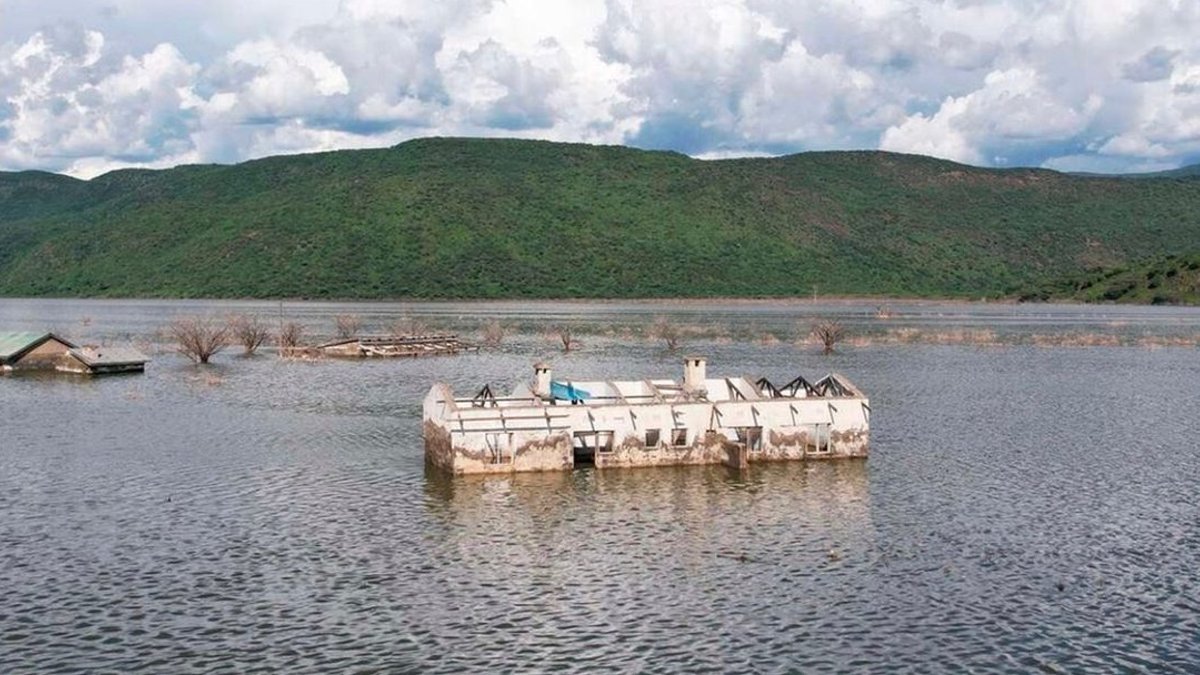
Lakes Bogoria and Baringo, two of Kenya’s most troubled lakes, are now less than three kilometres apart, prompting the government to intervene to prevent a merger. The distance between the two bodies of water has been decreasing due to rising levels, with Lake Bogoria advancing towards the homes, farms and businesses of residents in Loboi, Baringo South.
For years, the people of Loboi have seen their homes and farmland swallowed by rising waters, as Lake Bogoria encroaches ever closer. Jones Lewatchum, who has moved three times since 2012, now stays in a tent on borrowed land, no longer able to cultivate crops or keep animals as before.
Floodwaters Rise
Lake Baringo, Kenya’s sole freshwater body in the Rift Valley, has surged by about 12 to 14 meters in the last 15 years, swelling to hold roughly two billion cubic meters more water and stretching its surface from 108 to 130 square kilometers.
Because neither lake drains naturally, the overflow spreads outward, narrowing the space between them with each passing year.
Authorities have issued dire warnings: if the two lakes merge, the damage could be permanent. Defence Principal Secretary Patrick Mariru calls the risk of their convergence an imminent environmental catastrophe, emphasizing the need for immediate action.
Read Also: Kenyan doctors’ union calls for bill withdrawal
Ecological Disaster
The merger would threaten the flamingos, geothermal springs and unique micro-flora that depend on the chemical balance of each lake. The crisis has already taken a toll on the local community, with over 600 households displaced and businesses and farms destroyed.
In Mogotio Constituency, the flooding has grown even more unpredictable, with groundwater suddenly bursting from the ground and inundating fields overnight. The Marigat-Loruk road is now underwater, isolating communities, and the local clinic has had to move to a powerless facility.
Government Response
The government has begun moving towards a large-scale engineering response, with plans to divert excess water through a tunnel and canal system. The plan could serve two purposes at once: relieving pressure on the swelling lakes while opening arid land to commercial agriculture.
Professor Simon Onywere has suggested rerouting the Waseges River into Lake Baringo instead of Bogoria, then guiding its surplus toward the Suguta Valley to use the water for farming rather than allowing it to pose a hazard. Early technical reviews and cost analyses are reportedly in progress.
Families in Loboi and nearby areas continue to wait anxiously as the water levels creep higher, unsure when, or if, any solution will be put in place. The local health center has already been forced to relocate to a building without electricity.


Leave a Reply